

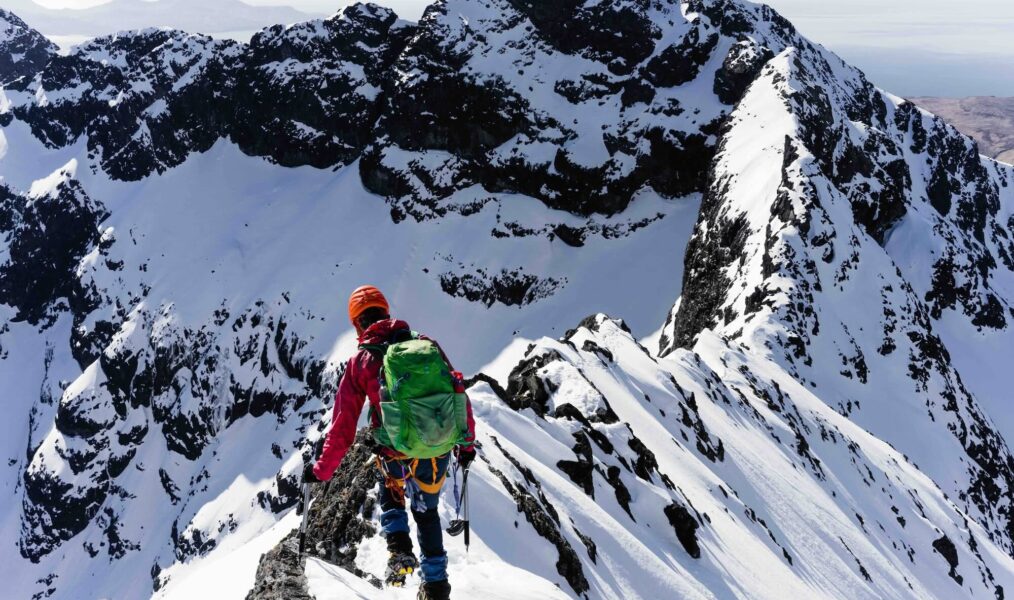


Skye-based mountaineering instructor Adrian Trendall gives valuable advice on tackling the famous Cuillin Ridge traverse in winter conditions…
The Cuillin is often described as Scotland’s answer to the Alps, and a traverse of the ridge in summer is indeed a route of epic proportions. Throw in snow and ice, and short daylight hours, and a winter traverse becomes a truly alpine climb. Consider what’s involved in completing the route – 12km of actual ridge, 4000m of ascent and descent, 12km of walk in/out, technical climbing, multiple abseils and continuous exposure – and you start to realise it’s no pushover, despite its relative lowly grade. It’s a big challenge and has a mythical reputation, an ephemeral route to be sought out.
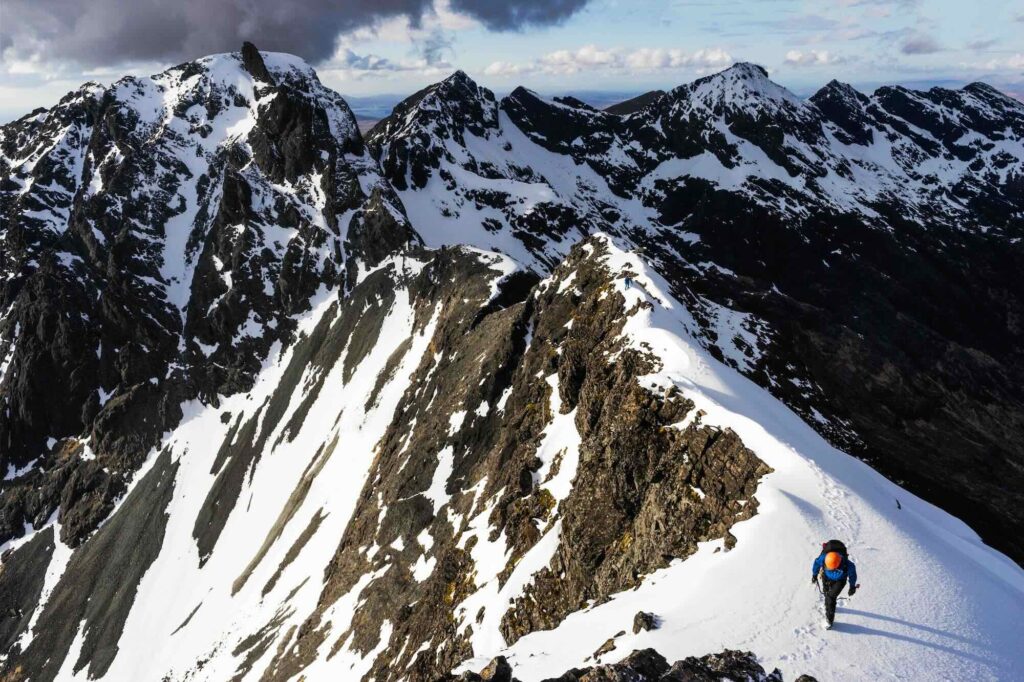
Climber nearing the summit of Sgurr Mhic Choinnich; the In Pinn is top left then Sgurr na Banachdich, Sgurr Thormaid, Sgurr a Ghreadaidh and the 4 tops of Sgurr a Mhadaidh
February 26th, 2018 was an auspicious day for both (Scottish alpinist) Uisdean Hawthorn and me. Uisdean set his blisteringly-fast winter traverse record of 4 hours, 57 minutes and 7 seconds. Cuillin conditions were sublime, as good as they ever get. No records for me, but it was the day I decided that I did actually want to do a winter Cuillin Ridge traverse. Up until then I always believed the tales I’d heard of it being a sufferfest; wading through deep snow, horrific bivis, complex route-finding… the scope for suffering was huge. But on that day conditions were perfect, and I saw a pair of climbers moving light and fast and aiming to do it in a single day. Put me down for some of that, please!
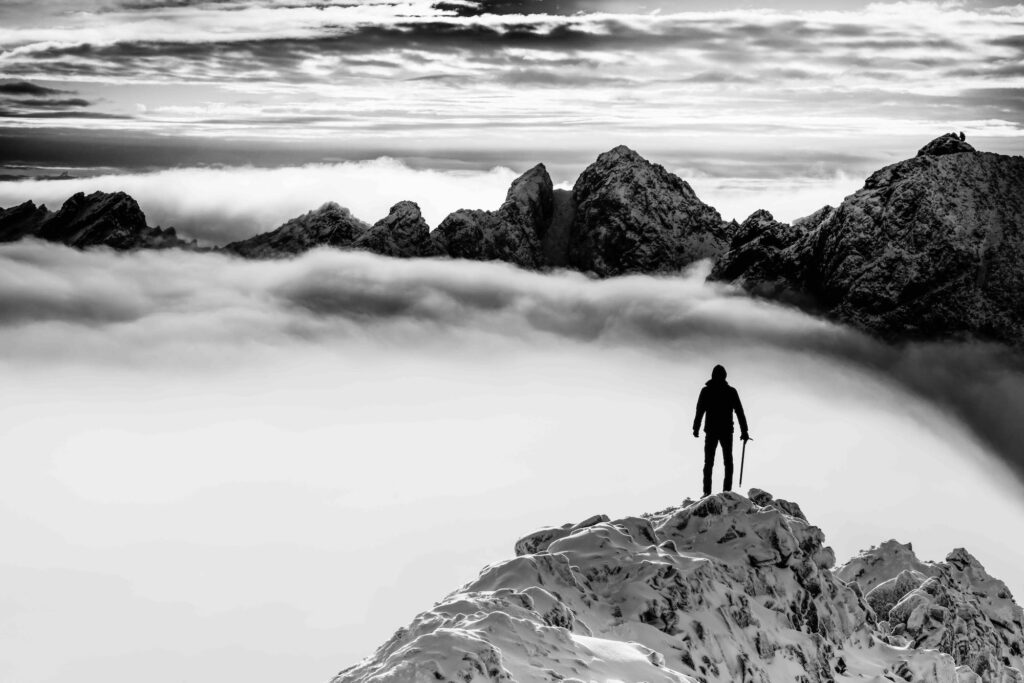
Temperature inversion; a climber high above the clouds on a snow-covered south ridge of Sgurr na Banachdich
The Cuillin Ridge deserves its reputation as the jewel in the crown of Scottish scrambling/easy climbing, but in winter conditions it becomes the equivalent of the Holy Grail – and almost as elusive. Starting on Sgurr nan Gillian and finishing on Gars-bheinn, what you do in between is very much a personal choice. Some will choose to do all 11 Munros including the outlying Sgurr Dubh Mor, some may tactically bypass Bidein or even the Inaccessible Pinnacle. Most will avoid the short wall out of the TD Gap, the crux of the whole ridge. After all, there’s always scope for a return match and a more complete traverse in better style.
How hard is it?
The SMC guide suggests a grade of IV overall with a technical grade of 6. IV doesn’t really encompass the overall difficulty and sheer length of the ridge. It might lack altitude but perhaps an alpine grade of D+ might be more fitting. Most of the ridge is grade II territory with short sections of III and a couple of pitches of IV. The east ridge of the Inaccessible Pinnacle (IV, 4) and the exit from the TD Gap (IV, 6) will be the cruxes, but both can be bypassed. The grades don’t sound hard by modern standards, but underestimate them at your peril. It’s important to remember that these grades are for good conditions and can rise a lot if conditions aren’t perfect, so be prepared depending on how the winter delivers.
Like a summer traverse, the vast majority of the ridge will need to be soloed, so the main skill is the ability to move reasonably fast and safely over terrain where a slip or fall could be your last. Confidence and fitness to traverse miles of exposed ridge will be the key to success.
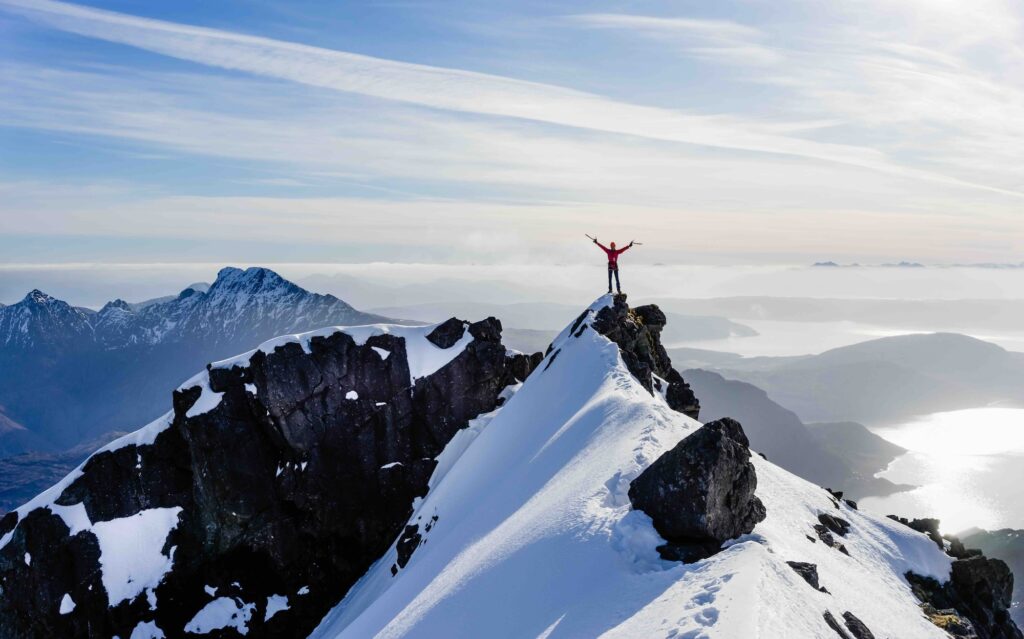
Climber on the summit of Sgurr Dubh Mor during a two day traverse; this outlying Munro is often missed out since it isn’t actually on the ridge
Preparation
Get the mileage in. There’s no substitute for being hill fit and having your winter climbing skills dialed in. Any big winter routes will be good training; better still, multiple routes or enchainments to simulate the distances involved. Tower Ridge on Ben Nevis and Liathach in Torridon are obvious training routes, but just keep in mind how much bigger the Cuillin Ridge will be. The best preparation would be an extended visit to Skye to recce bits of the ridge if you don’t already know it well. Whilst tempting to head to the technical difficulties like the In Pinn or TD Gap, time would be better spent getting to know the more complex sections such as Bidein and The Four tops of Sgurr a Mhadaidh. Either of these gives a good idea of the complex navigation involved, the exposure and some typical abseils.
Strategy
One day or two will be the primary decision, and this will be largely dependent on your fitness and experience levels. Back in 2018 I did the ridge twice in two weeks, so I’ll offer a few thoughts on both options. Two days will involve an overnight bivi with the consequent need to carry a lot of extra gear and this, together with the long, cold nights, makes things verge towards the sufferfest end of the spectrum. Traditionally, this has been the approach most people take and in perfect conditions it can be a great choice, really accentuating the alpine length and nature of the route. I have to confess that I never really considered this option seriously, due to not wanting to spoil the traverse with large packs.
The second time I did it was in a day, and now, with hindsight, that would be my preferred option. It was a mega-long day (awake for about 21 hours) but it felt more satisfying and a real bonus was not having to carry bivi gear or struggle to get going after a cold night out. I think many people will opt for this approach, especially if snow conditions are great. For many potential winter traversers, an ultra-long but lightweight day is preferable to two days with a big pack.
A third option is to cache bivi gear, or coerce friends into bringing it up for you. In many ways this is the best of all worlds, since you travel light yet get a bivi up high. However, you are absolutely dependent on reaching your preplaced gear. This was the option for my first traverse and worked really well, having all the pros and none of the cons – light packs and also a night out in the Cuillin – but it does require special friends (or, in my case, a wife) to ferry in and carry out all the bivi gear!
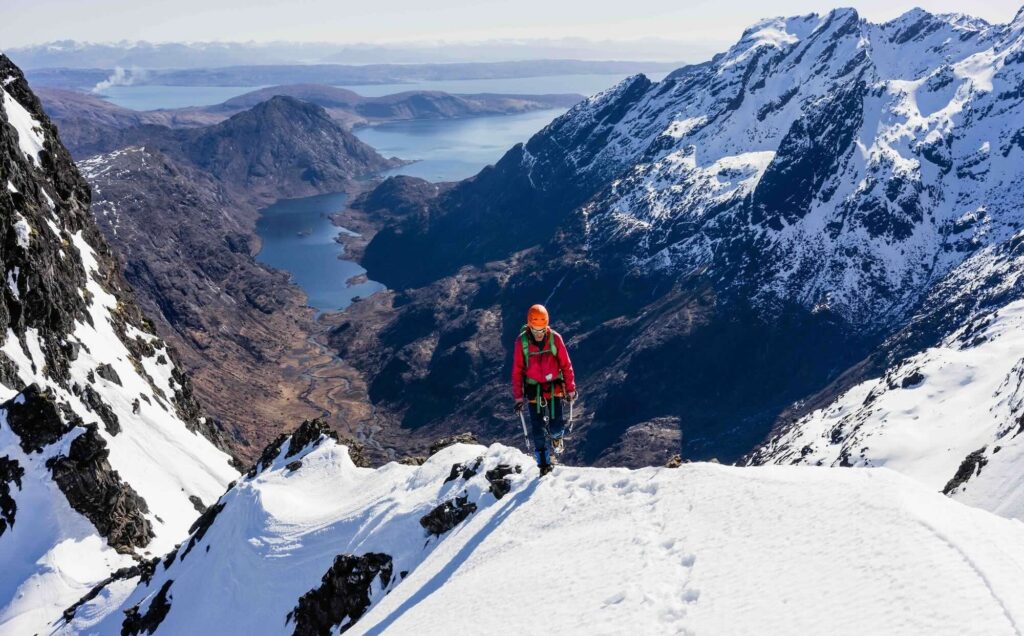
High above Loch Coruisk with Sgurr na Stri beyond it, heading up to the main summit of Sgurr a Mhadaidh
Tactics
Be flexible and ready to amend your plan on the hoof. There are bypasses available for some of the more technical or complicated bits of the route, so if progress is slow then consider traversing below Bidein on the Glen Brittle side, or descending out of the TD Gap on the Coire a Ghrunnda side rather than battling with the IV,6 exit climb.
On a more general note, do whatever possible to make things easy. Examples include ascending Sgurr nan Gillian by its west ridge and leaving your pack at the bealach rather than humping it up and down. Play to your strengths and divide roles accordingly; on my first traverse, my partner was by far the better climber and I had no qualms about letting him lead, since he’d be much faster. Conversely, route-finding was down to me due to my local knowledge.
Direction of travel
It makes sense to start on Sgurr nan Gillian and finish on Gars-bheinn, the opposite of a summer traverse. This means many difficulties can be abseiled, especially the Bhastier Tooth and King’s Chimney. The disadvantage of this is the finish on Gars-bheinn and especially the long walk out which can be a bit of an anti-climax.
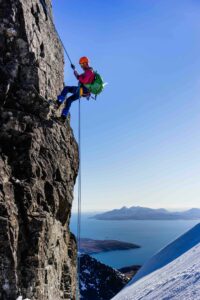
Sun, sea and snow; abseiling off the western end of the In Pinn, with the island of Rum visible in the distance
Abseils
Expect a lot of abseils. If the ridge has been busy then anchors will be in place, but it’s always best to have your own tat and a knife. Like everything on the ridge, the abseiling needs to be slick and efficient.
1. West Ridge, Sgurr nan Gillian, Tooth Chimney
2. Am Bastier
3. King’s Cave Chimney
4. North Peak of Bidein
5. Central Peak of Bidein
6. Second Top of Sgurr a Mhadaidh
7. Third Top of Sgurr a Mhadaidh
8. The Inaccessible Pinnacle
9. Sgurr Mhic Choinnich, King’s Chimney
10. TD Gap
The faff factor
With so much ground to cover there is no time for faffing. Everything needs to be well organised from rope handling and deployment to nutrition and hydration. Arrange your pack with essential near the top and ready to hand.
Clothing & Equipment
This is a route for experienced winter climbers only, so only a few basic points are made below. Anyone doing the ridge is assumed to have a good knowledge and experience level of winter skills and, as such, should already own the necessary gear and know how to use it. Given the length of the route, light is very much right so pare things to a minimum. Because this is a route that should only be entertained by experienced climbers these are just a few thoughts rather than a comprehensive list.
Climbing gear: This will very much depend on personal ability and conditions. Don’t go mad with a huge rack which will end up being carried for 95% of the route. We took a 60m rope, slings, Rocks 3, 4, 6, 8 and the three smallest Rockcentrics. You could probably just about get away with a 50m rope (the King’s Cave Chimney abseil is 25m, as is King’s Chimney) but the extra metres are definitely useful. Abseil tat and knife.
Axes and crampons: Simple and light – don’t need to be overly technical. I used an ancient pair of DMM Flys but Petzl Sum’Tecs would be ideal. Take two ice tools each.
Clothing: Light and functional. Personal favourites include Arcteryx Alpha FL and Marmot Precip overtrousers. Both are light and very functional. The likes of Rab, Mountain Equipment and Montane have suitable options of course. Gloves are crucial; take more pairs than you think necessary so you always have spares and dry ones available. During our perfect-condition traverse, I didn’t wear waterproofs at all, just softshell trousers and top.
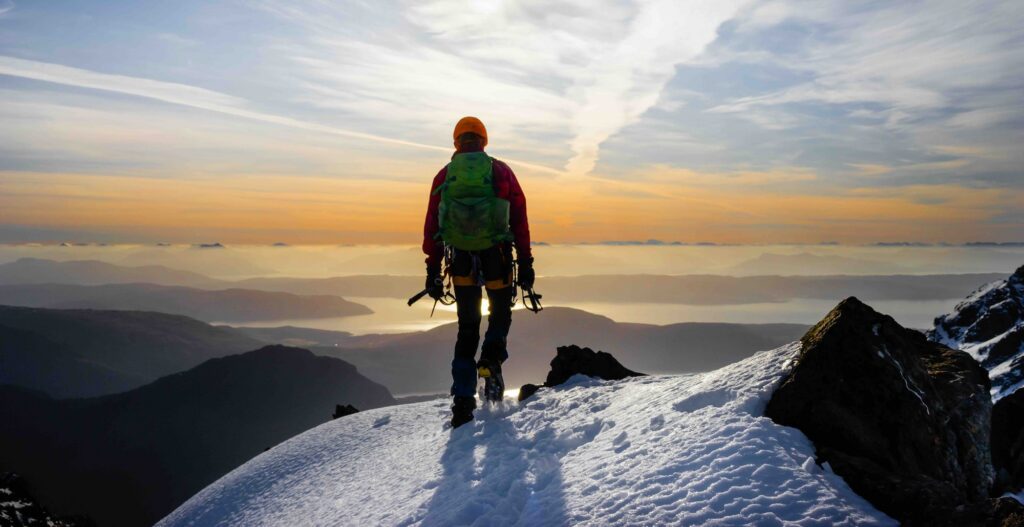
Sunrise on Sgurr Dubh na Da Bheinn; this is where you have to decide whether to head out to Sgurr Dubh Mor or miss it and head straight to Sgurr nan Eag and Gars-bheinn
Pack: Tough, light and simple. I use Built To Send’s X series, but there are suitable packs from the likes of Rab, Gregory, Deuter, Exped and so on.
Bivi gear: Nights can be very long so either be prepared to suffer or go well equipped and put up with a hefty pack. Keep gas cylinders in your sleeping bag so the cold doesn’t effect them. Melt water at night and fill water bottles so as to save time in the morning (and also serves as hot water bottles overnight).
Food and water
Depends on one or two day option but think of high energy and, above all, palatable. You are going to burn a huge amount of calories, so plan accordingly. Eat well the day before and eat little and often on the big day/s. Food is the fuel that will keep you going. Carry lots of snacks that are easily accessible in pockets for food on the go. If you bivi, it’s going to be a long night so have plenty of food, brew materials and gas. Unlike a summer traverse, water will not be an isuse. Consider taking a small gas stove even on a one-day attempt to melt snow. The morale boost of a hot drink is huge and the weight saving of not having to carry a day’s worth of water is great.
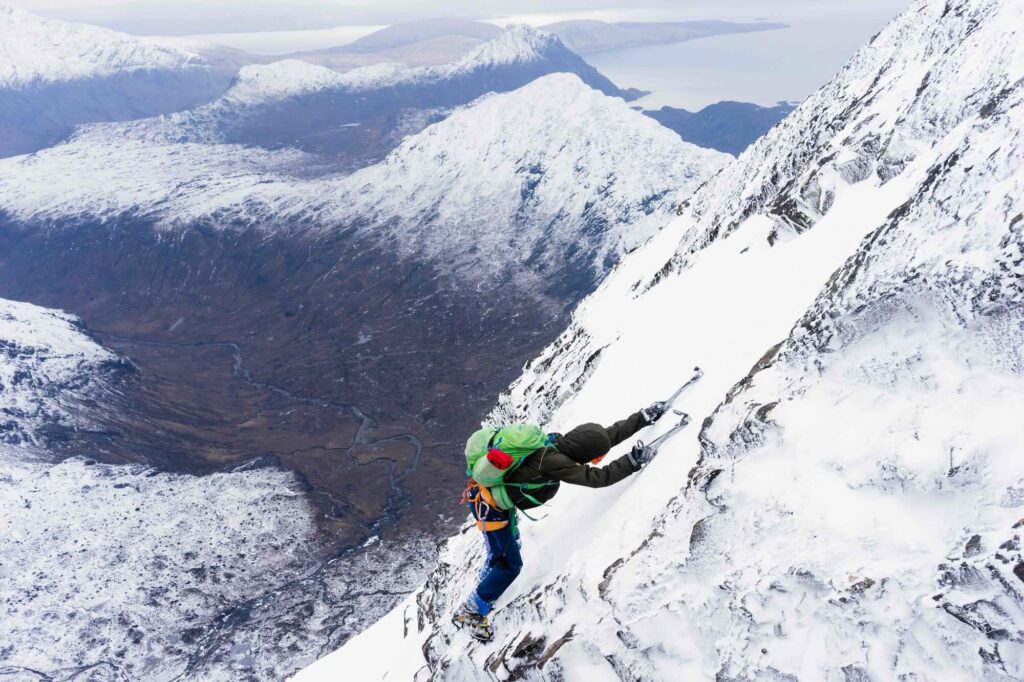
Typical easy – but very exposed – terrain high above Harta and Lota Coires on An Caisteal
Navigation
Prior knowledge of the ridge is good but winter-specific knowledge is best since you’ll be going in the opposite direction to summer. The Harvey Map is the gold standard for the Cuillin; its larger scale and greater detail is far superior to the Ordnance Survey. Maps and GPS are good but no substitute for previous knowledge and experience. If conditions are good then the ridge will probably receive a lot of interest, so the ridge may well be tracked out but don’t blindly follow the tracks; keep switched on and always have a degree of caution. Navigation is one of the reasons why good conditions are pretty much essential. Poor visibility will hamper progress unless you have an intimate knowledge of the ridge.
Weather and Conditions
The Cuillin weather is notoriously fickle, its proximity to the sea and the maritime climate making for rapidly changing conditions. Your best chance will be December to April, but suitable conditions may come and go fast so you need to keep an eye on forecasts and social media and be prepared to get to Skye PDQ. Heavy snowfall then a period of high pressure and stable weather is the key. According to one of the first ascentionists, Tom Patey, the major prerequisite is a heavy dump of snow with minimal wind so the white stuff is not stripped from the ridge. Next, a brief thaw right up to ridge level then a freeze followed by good stable weather would be ideal. Don’t be put off if the ridge looks black and snow-free from glen level, since the perfect conditions of consolidated snow on the crest may only be apparent from, well, on the ridge itself.
The winter ridge is a route worth waiting for. In pristine nick, both progress along it and the views will be bliss but the opposite is also true; deep, unconsolidated snow will just be hard graft. In those perfect conditions, some bits will be easier than in summer. The Bad Step on Am Bastier can be banked-out with snow. An Dorus is sometimes completely smoothed out, a graceful arc of compact nevee rather than the summer climb/scramble down and back out. Scree slopes, a curse in summer, can be a romp in winter.
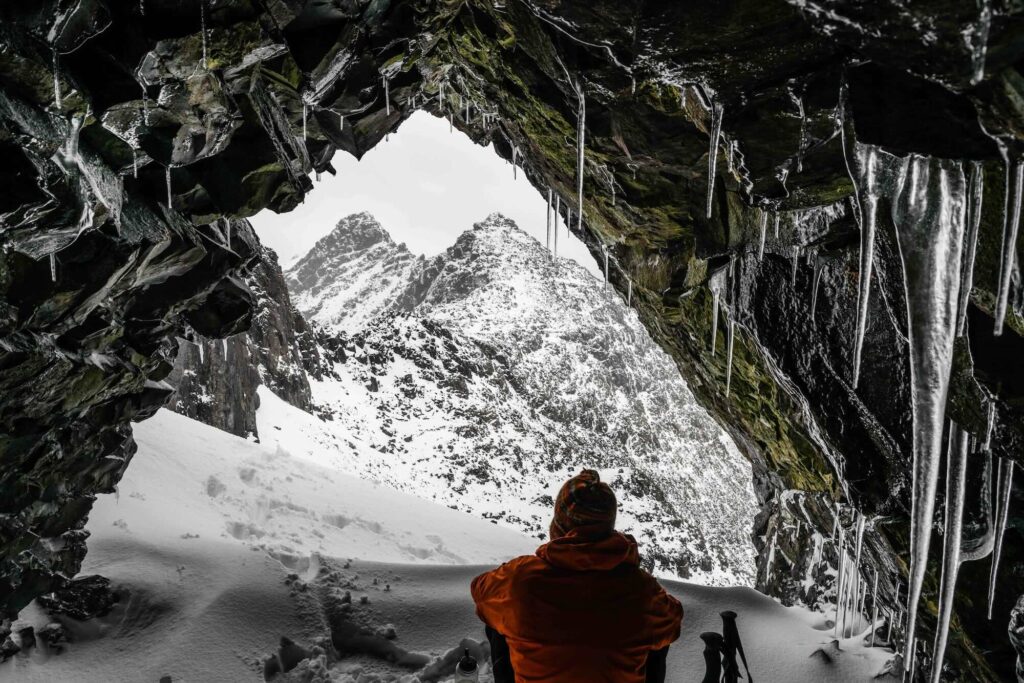
Climber in Sgurr Sgumain bivi cave; not quite on the ridge but a photo that shows the magic of the Cuillin in winter, and also a useful refuge to know about
Commitment
Although alpine in length, the Cuillin Ridge is fairly accessible. Skye might be a long drive from southern England, but once you are on the ridge it’s not as committing as its length and grade might suggest. There are multiple points where you can escape and be down on the Glen Brittle road in a couple of hours, which bodes well if the weather changes or you decide to abandon your attempt for various reasons. These are all marked in the Cicerone guide book (see details in the info box opposite).
Summary
If you are considering attempting a winter traverse of the Cuillin (and haven’t been put off by this article!), ideally you’ll be looking for;
- Well consolidated snow for fast and easy progress
- Good visibility to aid navigation
- Low winds
- A good level of fitness
- A suitable partner of equal ability, fitness and experience
- Time off work
Not quite lottery-winning odds exactly, but you are going to need a few stars in alignment for a good chance of success… and a big bag of luck never does any harm. It’s a challenge, but an achievable one for many, given good conditions. Another quote from Tom Patey sums things up beautifully; “there are many harder and more exacting routes and many more still to be explored, yet I feel confident that this achievement will retain its place as the greatest single adventure in winter mountaineering.”
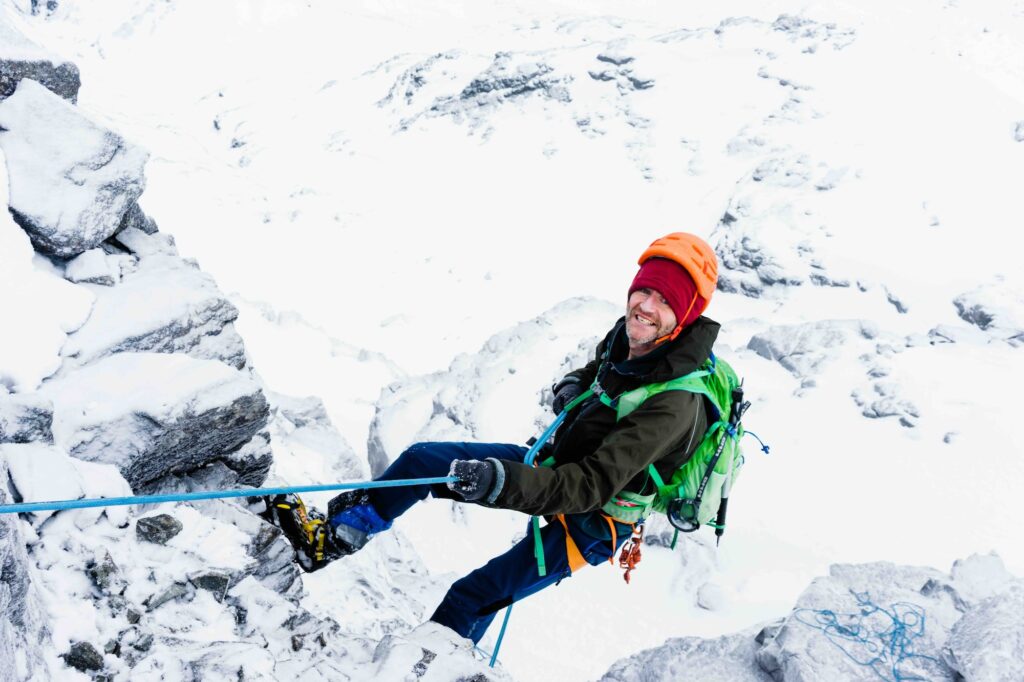
Abseil from Am Bastier
THE KNOWLEDGE
Getting there: A car is pretty much essential given the paucity of public transport in winter. Hitchhiking pre Covid used to be easy but now is all but impossible. Being a linear route, returning to your transport can be problematic and two cars make sense. Pre place one at Glen Brittle for the finish and return to Sligachan in the other for the start.
When to go: December to early April, but there are no guarantees that the route will be in condition even during those months.
Where to stay: The hardy and skint will sleep in their car or van but other possibilities are Skye Base Camp in Broadford and The Glen Brittle Memorial Hut or the bunkhouse at The Old Inn at Carbost.
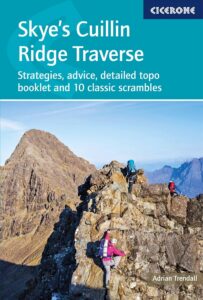
Guide book: Cicerone’s ‘Skye’s Cuillin Ridge Traverse’ (below), written by the author of this article is the definitive guide to tackling the Cuillin ridge in both winter and summer. Extensive use is made of photo topos to show the route and various options and bypasses. Waymarked points link the topos to 1:12,500 Harvey mapping and a route description. The book has been described by Simon Richardson of www.scotwinter.com thus: “Clearly a huge amount of local knowledge, experience, thought and care have gone into this production. Adrian Trendall and Cicerone should be congratulated for an outstanding publication.” For more info, go to
www.cicerone.co.uk
Further reading
The recently-published ‘Fox Of Glencoe’ is all about Hamish MacInnes but has a wonderful chapter by Tom Patey about the first-ever winter traverse, so it’s well worth a read – even just to let you know what you are letting yourself in for! More info at www.scottishmountaineeringpress.com
Adrian Trendall is a Skye-based outdoor instructor where he runs www.allthingscuillin.co.uk with his partner Bridgette Blackmore